The Great Social Media Privacy Crisis of 2026
Another tragedy unfolded recently.
Someone made public social media posts.
Then, in a shocking twist that no one could have predicted, other people saw them.
I know. Take a moment.
The sheer unpredictability of it all is difficult to process.
Apparently, there remains a persistent belief among certain corners of society that “public” means “visible only to people who already agree with me.”
Unfortunately, technology has not yet caught up to that dream.
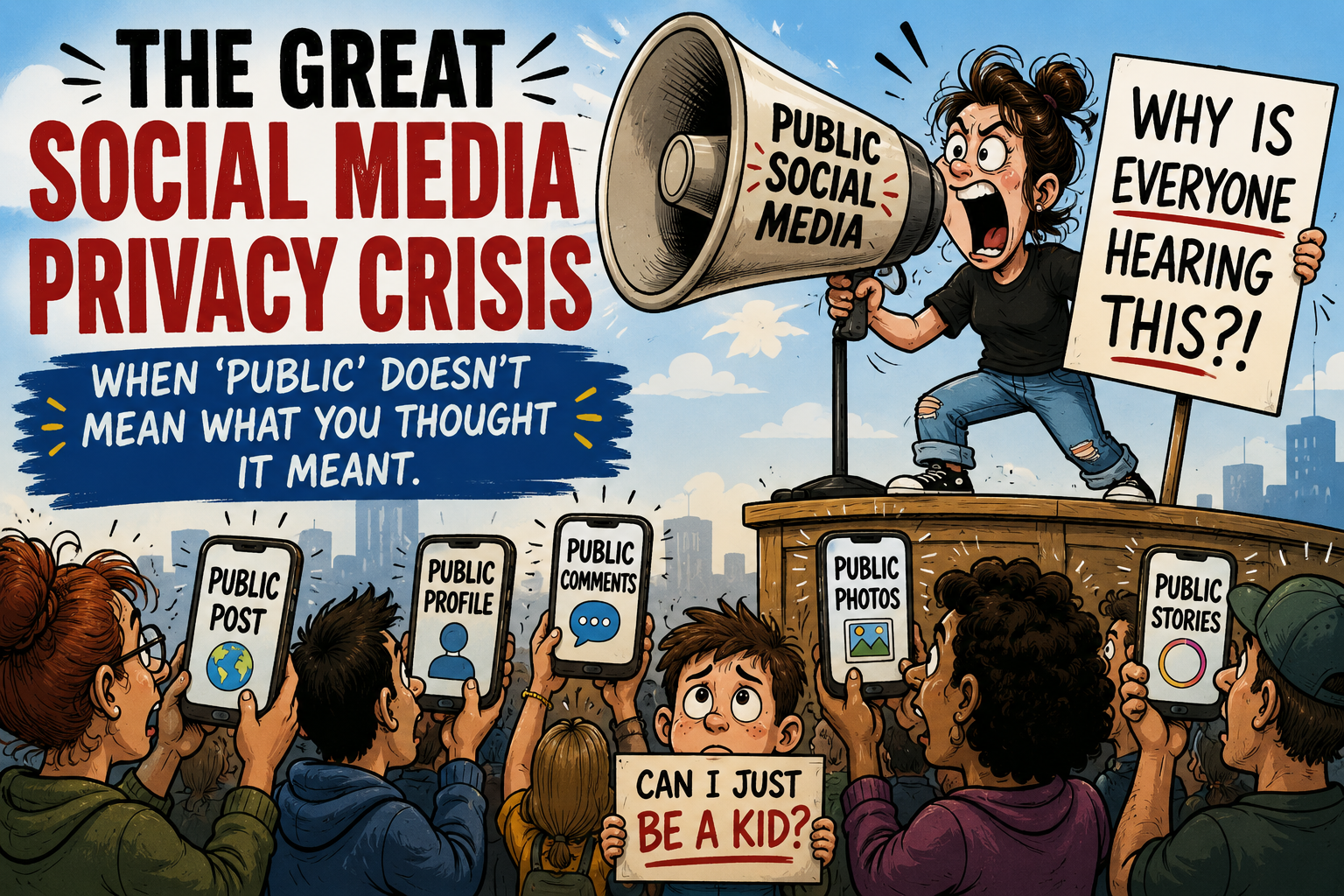
When you post something publicly, people can see it.
Friends can see it.
Family can see it.
Strangers can see it.
And in an especially cruel design flaw, the children who follow your account can see it too.
Terrifying.
Now, one might assume that if a person chooses to publicly post hateful comments about family members, complete with dramatic references to wishing a parent dead, they would understand there is a possibility that family members may become aware of those comments.
That would be an incorrect assumption.
Instead, the real outrage appears to be that someone noticed.
Not that it was posted.
Not that children could see it.
Not that a minor felt pressured to participate.
No, no.
The true injustice was discovery.
This is an important distinction.
Imagine a world where poor judgment could simply exist forever without consequence, accountability, or observation.
A magical world where public posts remain private, children remain unaffected, and everyone politely pretends not to notice obvious dysfunction.
Sadly, we do not live in that world. We live in a world where minors sometimes read social media. And sometimes those minors comment.
And sometimes, when asked about those comments, they admit they didn’t actually mean what they wrote and felt pressure to take sides in an adult conflict.
Which is exactly the point.
Children should not be recruited as supporting actors in someone else’s family drama.
They should not be asked to validate grievances.
They should not be expected to choose teams.
They should not be used as evidence.
And they certainly should not be carrying the emotional burden of conflicts they neither created nor understand.
Yet somehow, every time this happens, the conversation immediately shifts away from the adult who created the situation and toward the person who noticed it.
It’s an impressive bit of narrative gymnastics.
Step 1: Post something inappropriate.
Step 2: Make sure children can see it.
Step 3: Become upset when children see it.
Step 4: Become even more upset when adults discover children saw it.
Step 5: Declare yourself the victim.
Step 6: Repeat as necessary.
At no point is there reflection on whether publicly broadcasting family hostility where children have access might have been a poor choice.
That possibility is dismissed immediately because it interferes with the much more important task of manufacturing a fresh crisis.
Perhaps the most remarkable part is the accusation that reviewing public content somehow constitutes surveillance.
Let’s clear that up.
If a child has access to content, responsible adults should know what that content contains.
That isn’t spying.
That isn’t stalking.
That isn’t an invasion of privacy.
It’s called parenting.
Parents** monitor social media.
Parents check accounts.
Parents review posts.
Parents pay attention when children become involved in adult disputes.
This is not controversial. In fact, it would be far more concerning if they didn’t.
**Before anyone objects that I’m “not a parent,” let’s clear that up. I live with the children full-time, help raise them, and am married to their father, who has sole legal custody (for a very good reason). Parenting is determined by who shows up consistently for the children, not by who is most upset about it on social media. And the courts consider adults feeding them, driving them, helping with homework, attending school events, and dealing with their daily lives to be parental figures. End of story
So let this serve as a public service announcement:
If you post family drama on a public social media account that children can access, there is a non-zero chance that the adults responsible for those children may read it.
If that possibility feels invasive, there is a simple solution.
Do not post it.
The mystery has been solved.
You’re welcome.
P.S. When your phone is shut off because of your own behavior, that’s called a consequence. Not a crisis. Not a conspiracy. Not a police matter. Just a consequence.
I understand that’s a relatively new concept for some people.